
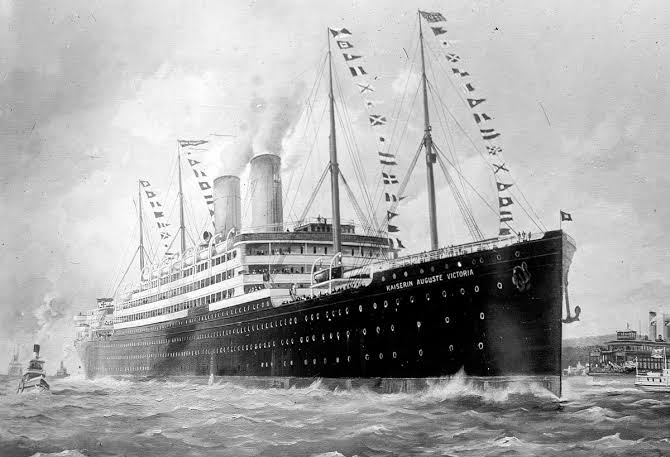
Ukrainians’ ability to travel from Galicia, part of the Austro-Hungarian Empire, to a German port such as Hamburg or Bremen to board a ship bound for the United States, often involved paying off the right “connected” bureaucrat. This was especially true in the turbulent years leading up to World War I. Officially, during that period, travel for Galician citizens was limited to Germany only and only for a limited duration stay, typically 6-9 months.
James Bratush, author of the book Historical Documentary of the Ukrainian Community of Rochester, New York, an immigrant to the United States from the village of Konyushky, Rohatyn District, wrote that after the Konyushky mayor refused to issue him a signed passport with his affixed seal, he and his father set out to an alternative passport agency, the Main District Office in the city of Rohatyn. The Rohatyn District clerk told the pair “You have nothing to worry about. If you want your son to get a passport you will have to pay two crowns ($0.63 in US currency) for the signature and seal of the mayor of the neighboring village of Putyatyntsi, who is a good friend of mine. Your son must remember however, that thereafter, he is not from the village of Konyushky, because his birthplace on the passport will be listed as Putyatyntsi. This passport will be valid for six months only. As soon as he reaches the German border, our agent will be waiting for him with another passport to America and will put him on the train to Hamburg. From there he will take the steamship Kaiserin Auguste Victoria to America.”
At no additional cost, the Rohatyn passport clerk provided some extra instructions as to “how to behave to prevent any suspicion by the police until reaching the German border.” Assurances were also given that after crossing the border, “there would be no more problems and nothing to fear.”
 FROM Putyatyntsi, Ukraine To ROCHESTER, New YORK
Leave a comment