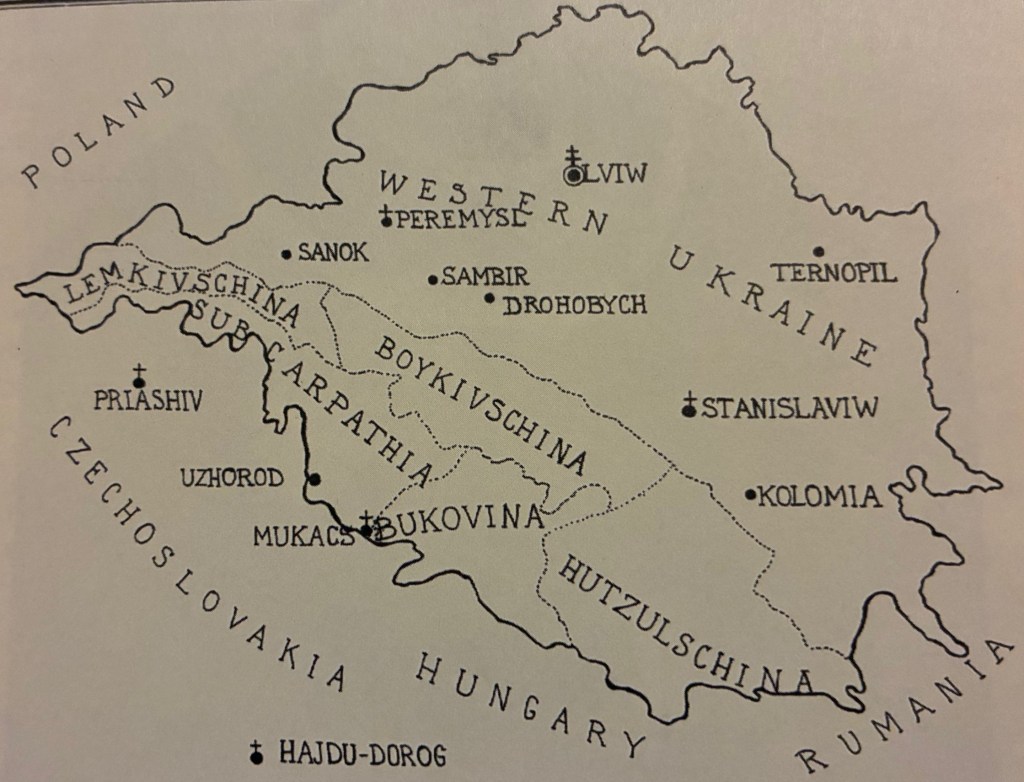
The above image is reproduced from the book Ukrainian Catholics in America: A History, 2nd Edition, written by Bohdan P. Procko, PhD. and edited by Rev. Dr. Ivan Kaszczak; published in 2016. Below are short excerpts from the book’s introduction, explaining who Ruthenians are and why that identification was used for immigrants from Galicia, Austro-Hungary prior to WWI.
Immigration documents such as ship manifests and census records often listed immigrants from Putyatyntsi’s ethnicity as Ruthenian or Galician. This confuses the national origin of the immigrant. Bohdan Procko writes that “Today, the national name Ukrainian is used by the descendants of the immigrants from Galicia and Bukovina, while the names Rusyn or Ruthenian are preferred by those originating from Transcarpathia.”
“It was from the territories of present day Ukraine, under political control of Austria-Hungary, that the mass Ukrainian immigration to the United States began in the last quarter of the nineteenth century. Virtually all of those immigrants were Catholics of the Byzantine-Slavic rite in communion with Rome. The Byzantine rite is the name applied to the forms and laws developed by the Church of Constantinople (Byzantium).” “The particular discipline followed by the Ukrainians, and other Slavic groups, used Church Slavonic as their language of worship prior to the reforms of Vatican II – thus the term Byzantine-Slavic rite.”
“The new immigrants were generally known as Ruthenians, a term the Medieval Latin sources usually applied to the western groups of the Eastern Slavs. The name is a Latinization of Slavic Rusyny (Rusini) which is derived from Kievan Rus. Since at least the end of the sixteenth century the term has been used by the Papacy as a common name for those peoples of the Byzantine rite who inhabited a region of Europe situated roughly between Lithuania in the North and the Carpathian mountains in the South.”
“With the rise of national consciousness in the latter part of the nineteenth and early twentieth centuries, the peoples of this region became generally known by national names, such as Ukrainians, Byelorussians, Rusyns, Carpatho-Russians, and Slovaks. The particular discipline of the Byzantine rite that these people followed continued, however, to be referred to Ruthenian.”
The document trail for immigrants from Putyatyntsi may say Ruthenian or Galician, but upon further investigation, one will find that these immigrants were proud Ukrainians. The language spoken at home was Ukrainian. The institutions, businesses and social connections established in Rochester, New York served to help other Ukrainians in the diaspora adjust and adapt to a new life in a new country.
 FROM Putyatyntsi, Ukraine To ROCHESTER, New YORK
Leave a comment