
Between 1900 and 2000, U.S. immigration policy for Eastern Europeans shifted from a period of relatively open borders to severe restriction based on national origins, and finally to a system focused on family reunification and refugee status.
1900–1920: The “Great Wave” and Growing Restrictions
At the turn of the century, Eastern Europeans (primarily from Poland, Russia, and the Austro-Hungarian Empire) arrived in record numbers, often fleeing economic hardship or religious persecution.
- Open Doors at Ellis Island: Between 1900 and 1915, more than 15 million immigrants arrived, with many settling in major industrial cities.
- Rising Nativism: Increased arrivals led to political pressure for restrictions. The Dillingham Commission (1907–1911) concluded that Eastern and Southern Europeans were “inferior” and recommended curbs on their entry.
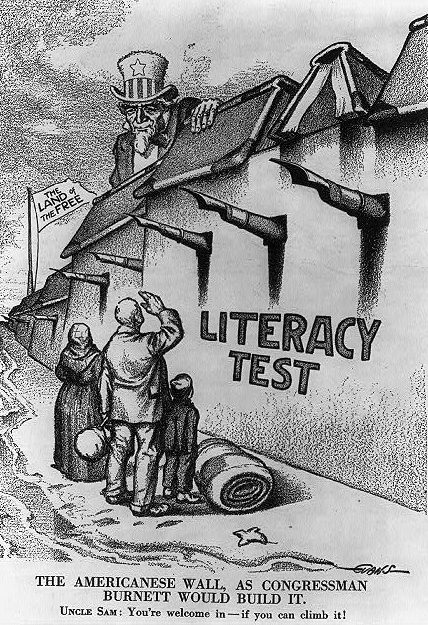
- Literacy Test (1917): Congress passed the Immigration Act of 1917, which required a literacy test for immigrants over age 16. This was specifically designed to reduce the flow of “low-skilled” immigrants from Southern and Eastern Europe.
1921–1964: The Era of National Origins Quotas
Following World War I, the U.S. moved toward a highly restrictive quota system that explicitly favored Western Europeans over Eastern Europeans.
- Emergency Quota Act of 1921: This was the first law to create numerical quotas, capped at 3% of a nationality’s foreign-born population based on the 1910 census.
- Immigration Act of 1924 (Johnson-Reed Act): This act tightened the quota further to 2% and used the 1890 census as its baseline. Because fewer Eastern Europeans were in the U.S. in 1890 compared to 1910, this effectively slashed Eastern European immigration by roughly 90%.
- McCarran-Walter Act (1952): While it slightly revised the quotas, it reaffirmed the national origins system during the early Cold War.
1965–2000: Abolition of Quotas and Refugee Status
The civil rights era brought a fundamental shift in how the U.S. selected immigrants.
- Immigration and Nationality Act of 1965: This landmark law abolished the national origins quota system. It replaced it with a preference system based on family reunification and professional skills.
- Refugee Acts (1948–1980): During the Cold War, special provisions like the Refugee Relief Act of 1953 allowed Eastern Europeans fleeing communist regimes to enter outside of standard caps.
- Post-Cold War Trends: By the 1990s, Eastern European immigration grew again, peaking as the Soviet Union collapsed and the U.S. expanded programs like the Diversity Visa to encourage migration from underrepresented regions.
Putyatyntsi Immigrants By the Numbers
As documented in books such as the Free Cossacks, Anniversary Jubilee Book of the Ukrainian Civic Center, Rochester New York, the applicable statistics regarding immigrants from Putyatyntsi are as follows.
320 Immigrants arrived prior to WWI
8 Immigrants arrived shortly after WWII
0 Immigrants after 1952
82 Immigrants (26%) returned home after WWI having left wives and children behind in the village
18 Immigrants (6%) moved from Rochester to other US cities
As of 1970,
162 Immigrants (49%) had died and were buried in Rochester cemeteries, presumably never having had the opportunity to revisit their homeland and families left behind.
55 (17%) Immigrant pioneers and their families were still members of the Rochester Ukrainian Civic Center at 831 Joseph Avenue.
There are small discrepancies, between various sources. Presumably with additional research, these discrepancies can be resolved.
 FROM Putyatyntsi, Ukraine To ROCHESTER, New YORK
Leave a comment