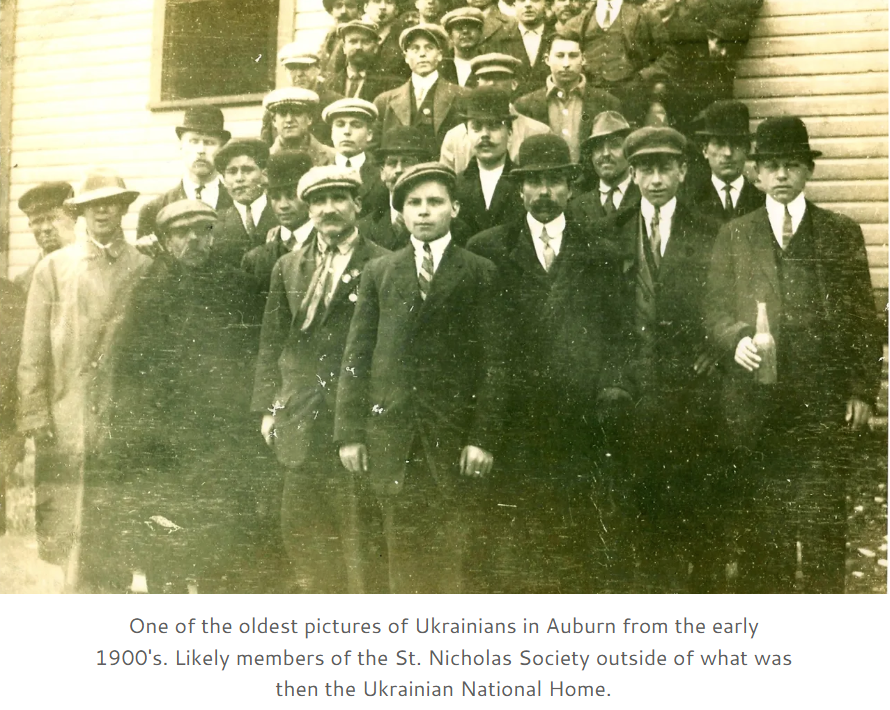
The above image and text was obtained from the St. Peter & Paul Ukrainian Catholic Church of Auburn, New York’s website: https://peterandpaulukr.com/history
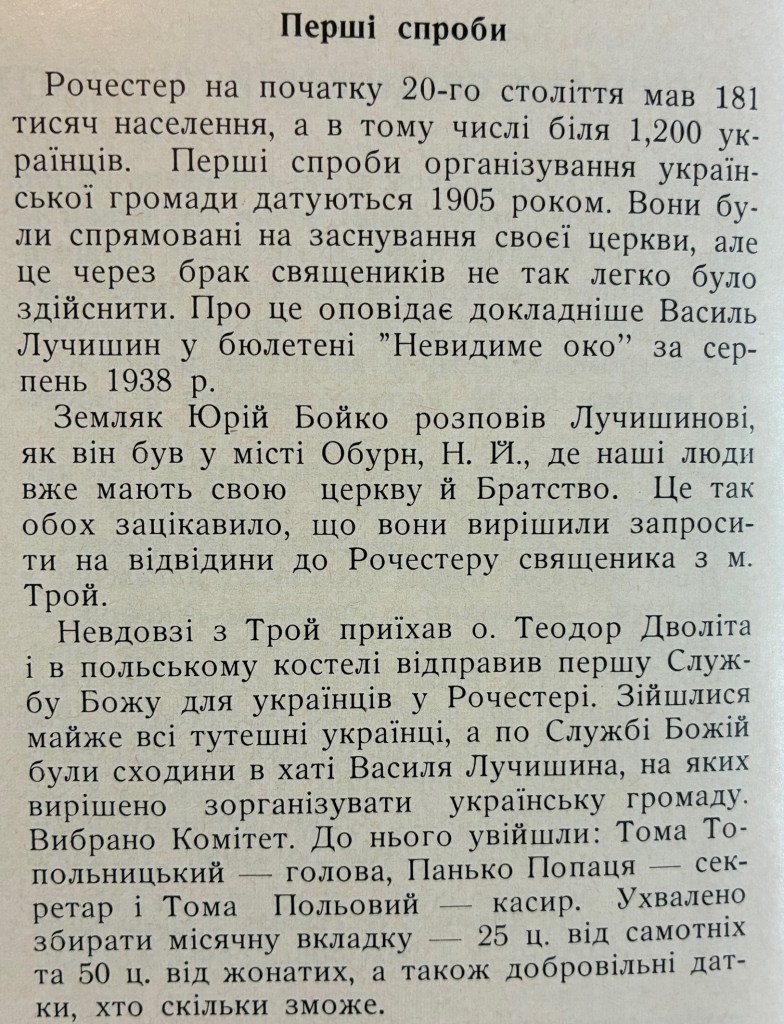
The article above is from the book Free Cossacks, Anniversary Jubilee Book of the Ukrainian Civic Center, Rochester New York, page 6, published in 1970. The three paragraphs are translated below.
First Attempts
At the beginning of the 20th century, Rochester had a population of 181,000 including about 1,200 Ukrainians. The first attempts to organize a Ukrainian community date back to 1905. These attempts were aimed at founding a Ruthenian church, but this was not so easy to achieve due to the lack of priests. Vasyl Lucyshyn tells about this in more detail in the bulletin “Nevidime oko”, “The Invisible Eye” in August 1938.
Fellow countryman Yuriy Boyko told Vasyl Lucyshyn about his visit to Auburn, N.Y., where our people already have their own church and Brotherhood. This interested both of them so much that they decided to invite a priest from Troy, N.Y., to visit Rochester.
Soon, Father Theodore Dvolita arrived from Troy and held the first Divine Service for Ukrainians in Rochester in a Polish church. Almost all the local Ukrainians gathered. After the Divine Service there was a meeting in the house of Vasyl Lucyshyn, at which it was decided to organize the Ukrainian community. A Committee was elected. It included: Toma Topolnytsky – chairman, Panko Popatsia – secretary and Toma Polovy – cashier. It was decided to collect a monthly contribution – 25 cents from singles and 50 cents from married people, as well as voluntary contributions, whoever can.
At this time in Rochester, many of the early immigrants were lonely, homesick, and frustrated, living in cramped boarding houses. Their living and working conditions were extraordinarily challenging. Work hours were long, exhausting, and poorly paid, at a rate of only 10 – 15 cents per hour. Many workplace accidents caused injury or death. There was no health or life insurance available for the workers. Immigrants were likely still repaying the loans taken out for ship fares for passage to the United States. Due to extreme poverty back in their home villages, immigrants were also expected to make remittances to families left behind.
What seemed to be modest monthly contributions requested for establishing the first Ruthenian church (now known as the Ukrainian Catholic Church) required significant sacrifices. Two of the industrious, community minded leaders named above, Vasyl Lucyshyn and Thomas Polovy, were immigrants from Putyatyntsi. They wanted to alleviate many of the challenges that they and their fellow countrymen were experiencing by building a community support network that would allow immigrants to help one another. These two immigrants were among the first pioneer leaders, with the courage and stamina to seed the ideas and begin the process of establishing the Ukrainian institutions that are still thriving in Rochester, New York, well into the 21st century.
 FROM Putyatyntsi, Ukraine To ROCHESTER, New YORK
Leave a comment