
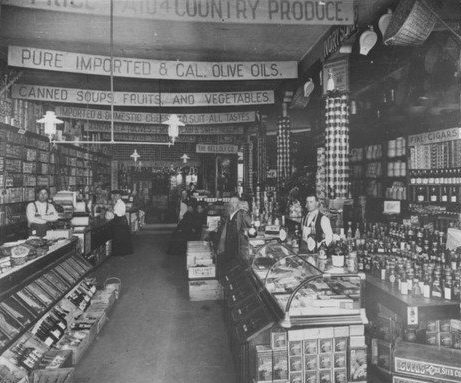
Wasyl Kuchmy’s failed shop, detailed in “Failure is not Fatal”, and Paul Makohin’s similar solo entrepreneurial failed attempt, taught Rochester’s Ukrainian immigrants a hard lesson: one man alone didn’t have the capital or the customer base to compete with the established local Polish and Jewish merchants. So the community tried a different model, cooperation instead of individual risk.
The first Ukrainian grocery cooperative was organized in 1914 by Peter Klymciv and V. Shklaryk. The idea was straightforward: Rochester’s Ukrainians now numbered in the hundreds, more than enough to sustain a single store if they simply agreed to buy from their own. James Bratush, in his Historical Documentary of the Ukrainian Community of Rochester, New York (p. 16), lays out why it wasn’t that simple.
Many families were bound to their old Jewish grocers by debt and credit, not preference. The grocers worked to keep it that way, reminding customers how easily they could buy without paying on the spot, a real advantage when unemployment was common and cash was scarce. The Ukrainian cooperative tried to compete on the same terms, extending credit of its own. But buying on credit from a stranger and buying on credit from a fellow villager felt different. Housewives, embarrassed to ask their own countrymen for what they wouldn’t hesitate to ask a Jewish grocer, often did without instead, or quietly went back to where they’d shopped before. The store extended trust it couldn’t recover, and within a short time it closed.
That failure didn’t end the idea, it just changed its shape. A second, more ambitious attempt followed, the Free Cossacks Society and the Enlightening Circle joined forces to open a cooperative department store at Remington and Kohlman Streets. It had organizational backing this time, and even weathered some early political opposition, Bratush notes that socialist-aligned members of the community campaigned against it, though their influence proved “small and of minor consequence.”
For a while, it looked like the second attempt might succeed where the first hadn’t. When St. Josaphat’s Church moved to Hudson Avenue, the cooperative followed the congregation to a new location on Joseph Avenue, between Nassau and Kelly Streets, and gained a prominent new member in Fr. Stephen Waschyshyn. Under manager Michael Binazevsky, both customer numbers and order volume grew.
But the underlying problem hadn’t gone away. A large share of customers either had no cash on hand or had simply grown used to not paying at the time of purchase. As unpaid bills accumulated, the cooperative’s finances gave out, and like its predecessor before it, the store was forced into liquidation.
Two attempts, five years apart, undone by the same weakness: a community eager to buy Ukrainian, but not always able, or willing, to pay for it up front.
Source: James D. Bratush, A Historical Documentary of the Ukrainian Community of Rochester, New York (1973), p. 16, 17.


Leave a comment