
Iwan Galuga was born in Putyatyntsi on 14 February 1923. By July 1944, aged 21, he was in Regensburg, Bavaria, and over the next three years German offices there and in nearby Kelheim wrote his name on a series of lists. Those lists survive in the Arolsen Archives, and scans of thirteen pages are reproduced below.
Together they show how much one free online archive can reveal about a single person: where he lived, who employed him, what he was paid, which offices kept files on him, and even how his nationality was written down. They also show what such records cannot tell us. This post sets out the evidence, marks where we are inferring, and lists the questions that remain open.
Records searched October 2026. The Arolsen Archives add new documents regularly, so this post is a snapshot of what was findable at that time. If you have found more on Iwan, or spot an error, please tell us in the comments.
What the Arolsen Archives are
The Arolsen Archives, in Bad Arolsen, Germany, are an international center on Nazi persecution. Their collections, formerly held by the International Tracing Service (ITS), document millions of people, including forced laborers and displaced persons, and can be searched online for free.
Many of the pages below come from a postwar effort to locate missing people. Local offices and employers compiled lists of foreigners and of the records kept about them, on standard forms headed Kategorie III. Three form types appear here. Form 7 lists foreigners who were stationed in a community but are no longer living there. Form 10 lists judicial and official records, such as police files. Form 11 lists social-security and labor-office records. Each carries a red “ITS” number stamped by the archive, which is a handy way to cite and find a page again.
What the records agree on
- Who: Iwan Galuga (Іван Галуга in Ukrainian; typed “Jwan” on several lists), born 14 February 1923. Every list that gives a birthplace points to Putyatyntsi (Путятинці in Ukrainian, Putiatyńce in Polish), spelled four different ways, and two of them add Kreis (district) Rohatyn.
- Arrival to Regensburg: Three separate offices give almost the same start: the police 9 July 1944, the employer and the health-insurance office 10 July 1944.
- Work: A helper at the Süddeutsche Holzverzuckerungswerke A.-G. in Regensburg, a wood-saccharification works, until 22 April 1945. A wage list shows 54.95 Reichsmark for April 1945. NOTE: A wood-saccharification works is an industrial plant that converts the complex carbohydrates found in wood (cellulose and hemicellulose) into simple, fermentable sugars through chemical or enzymatic hydrolysis. These sugars are then primarily used to produce alternative liquid fuels like bioethanol, biochemicals, or animal feed.
- After the war: Offices in Regensburg and Kelheim still held records on him in 1946 and 1947. These lists are retrospective rolls of records, so they prove the records existed, not that he was standing in the office that day.
Regensburg and Kelheim, about 25 km apart on the Danube in Bavaria.
Timeline of the documents
| Date | Office and form | Entry for Iwan Galuga | ITS |
|---|---|---|---|
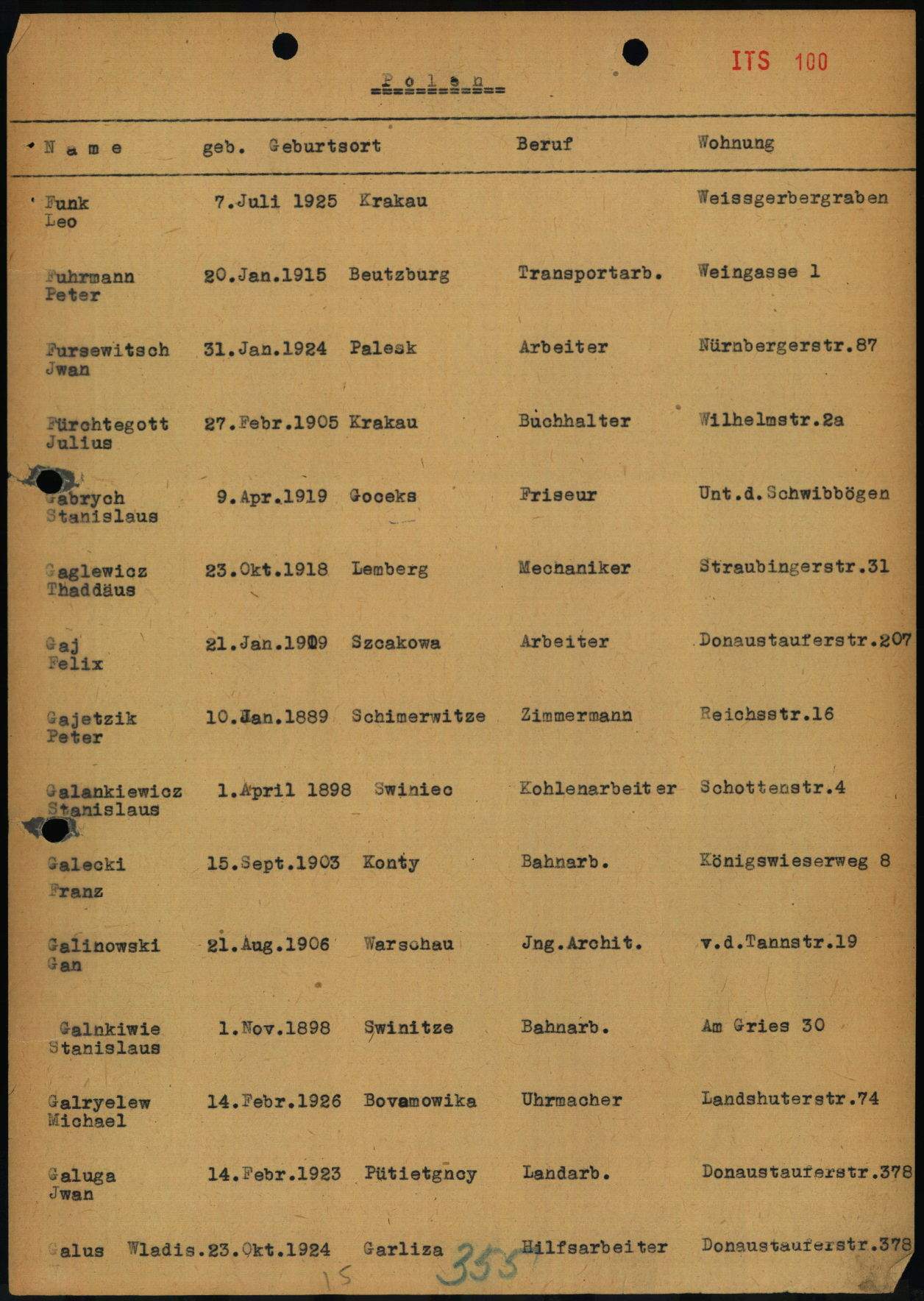
| Undated, about mid-1944 (inferred) | List of Poles with addresses | Farm laborer, Donaustaufer Str. 378 | 100 |
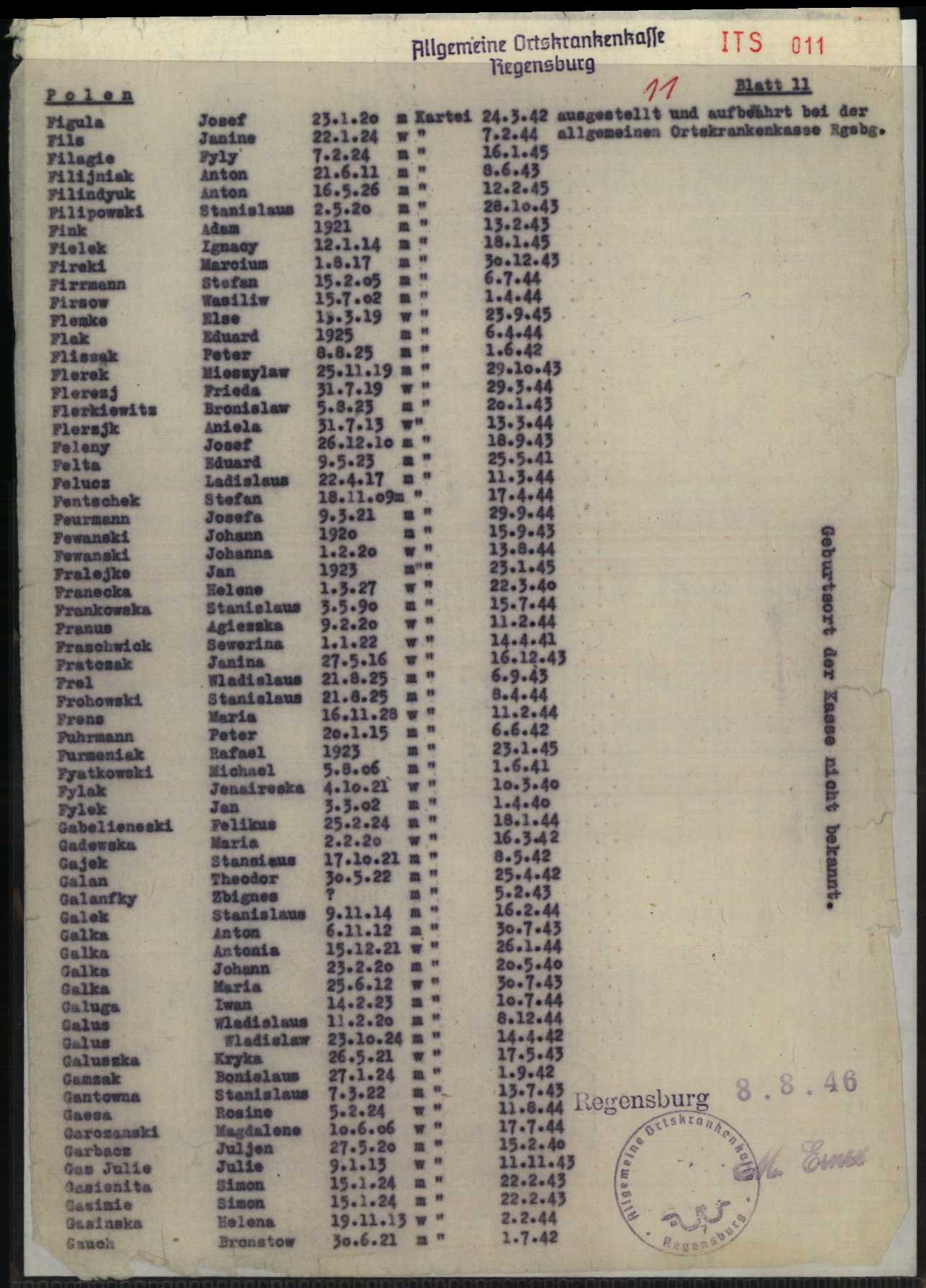
| 8 Aug 1946 | Health-insurance office (AOK) Regensburg, card list | Born 14.2.23, card dated 10.7.44 | 011 |
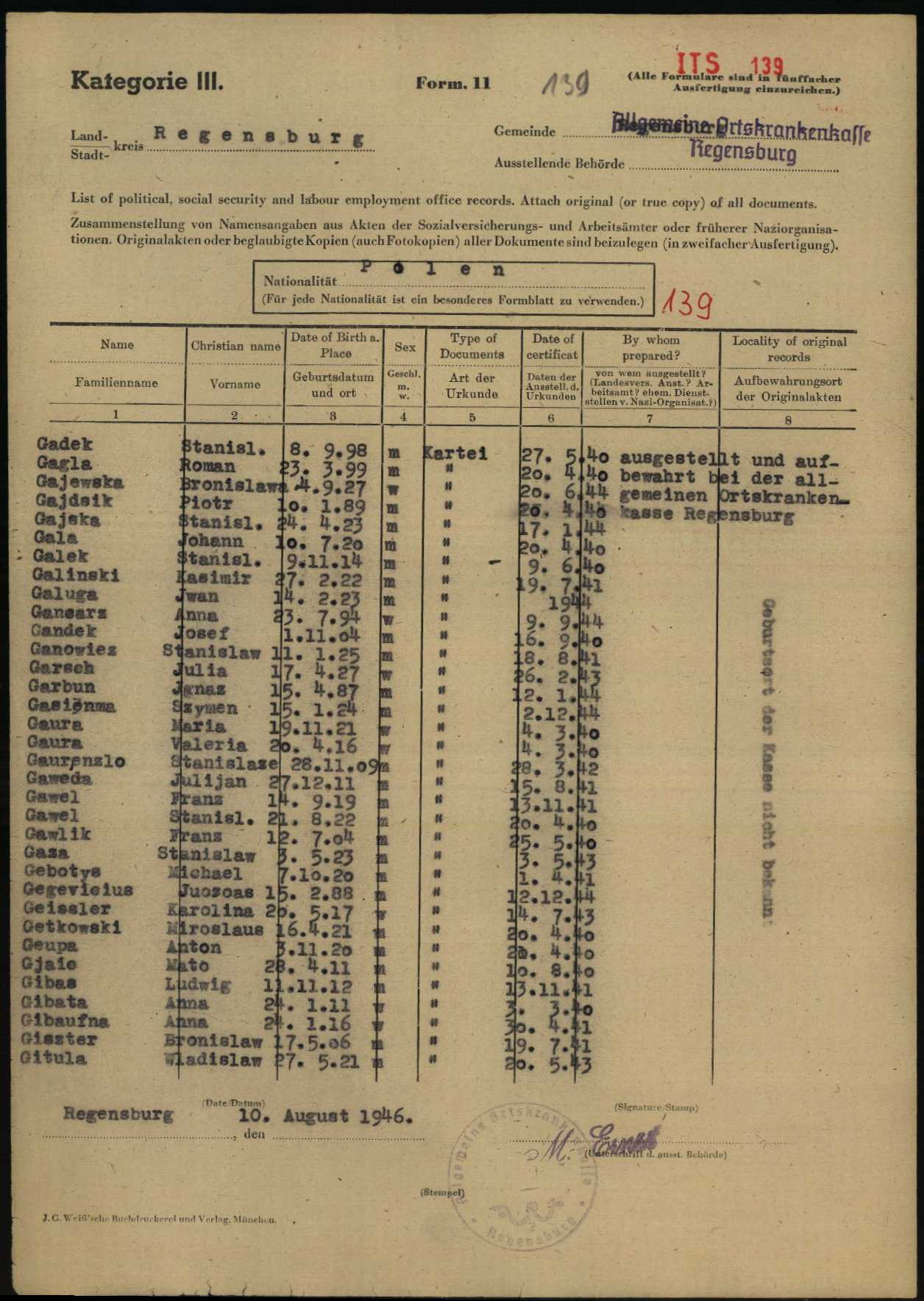
| 10 Aug 1946 | AOK Regensburg, Form 11 | Born 14.2.23, certificate 1944 | 139 |
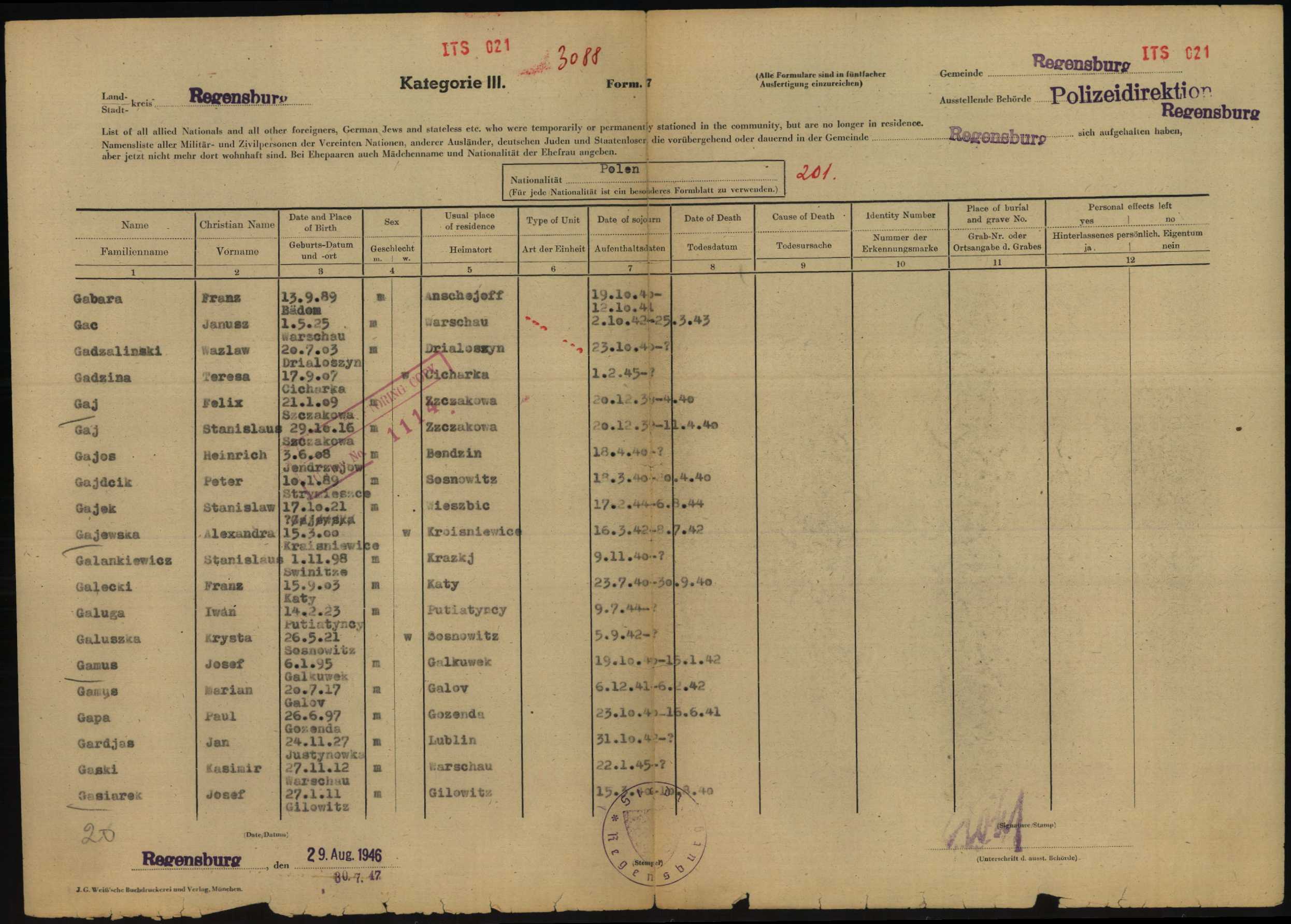
| 29 Aug 1946 | Police, Regensburg, Form 7 | In Regensburg from 9.7.44, end date “?” | 021 |
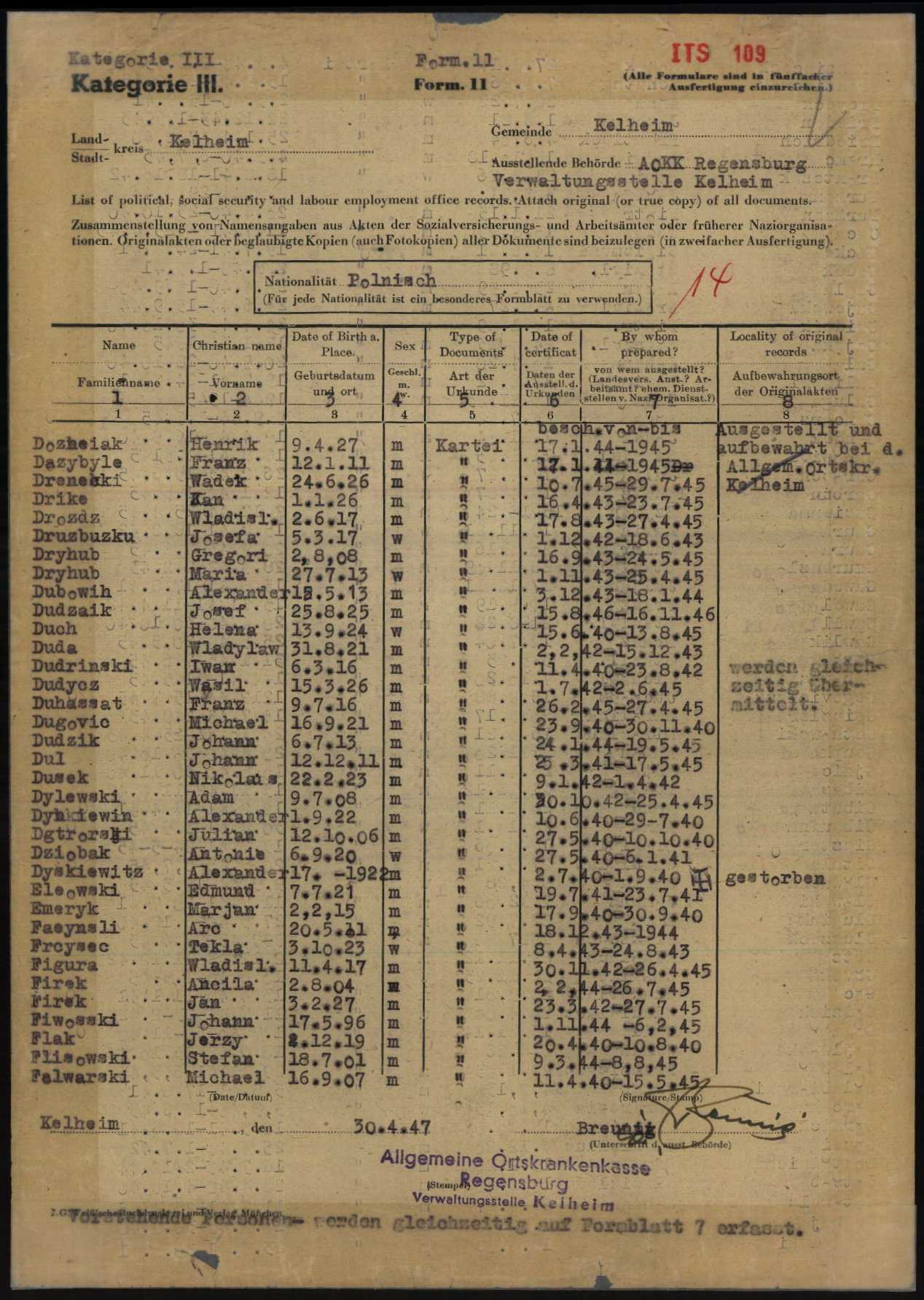
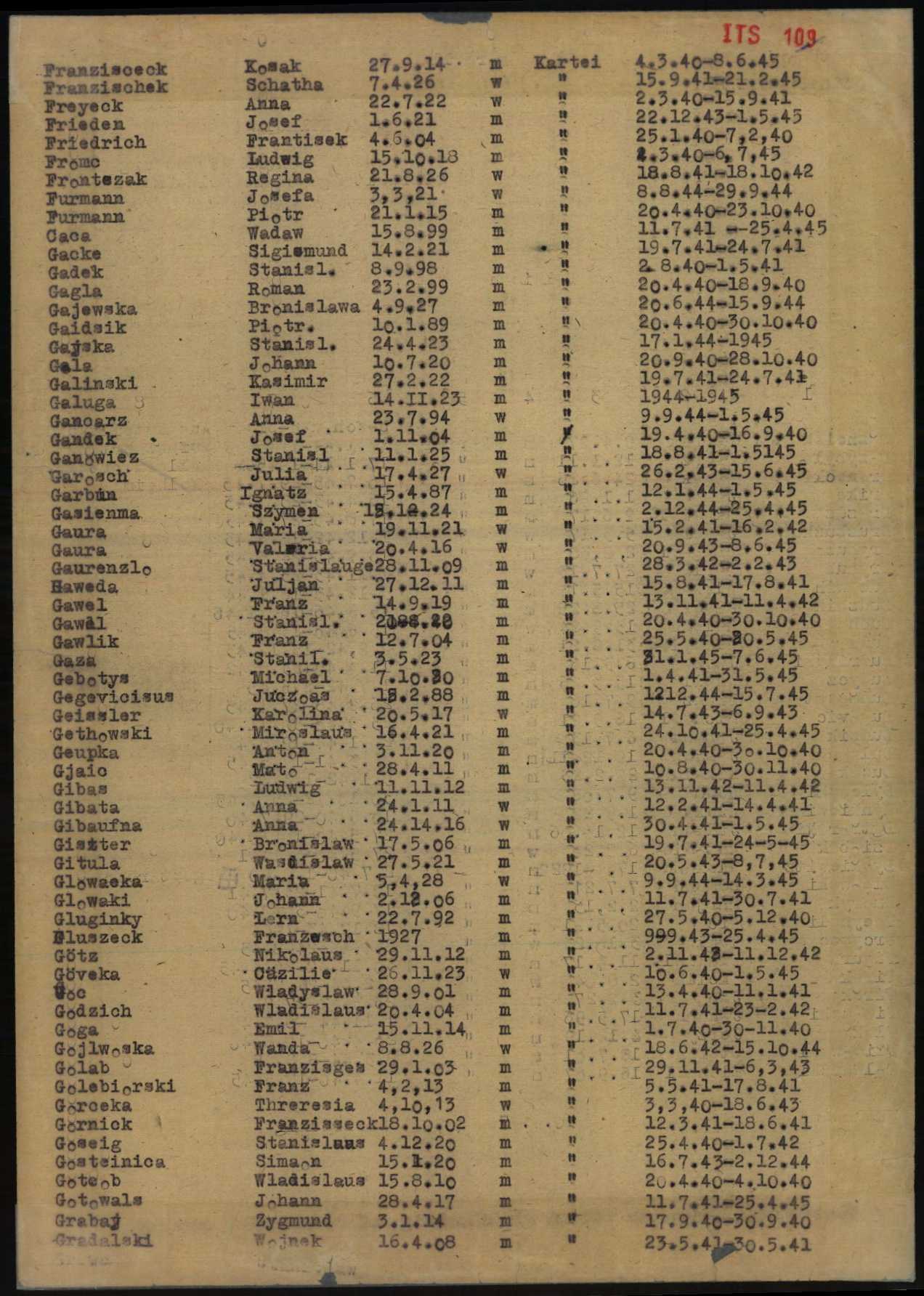
| 30 Apr 1947 | AOK Regensburg, Kelheim office, Form 11 | Insurance card 1944–1945 | 109 |
| 28 May 1947 | Süddeutsche Holzverzuckerungswerke, Form 7 | Helper, 10.7.44 to 22.4.45 | 150 |
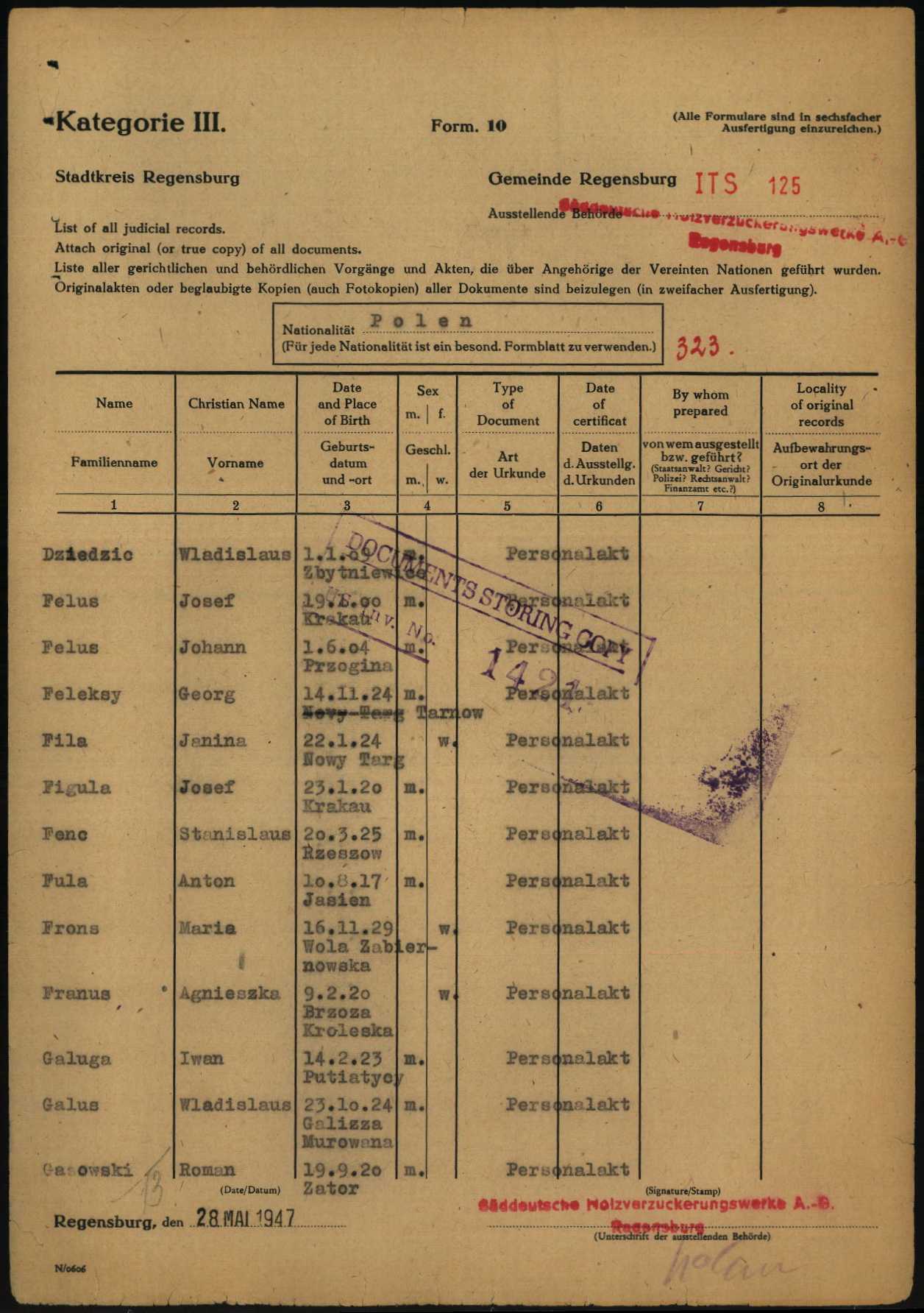
| 28 May 1947 | Same employer, Form 10 | A personnel file (Personalakt) existed | 125 |
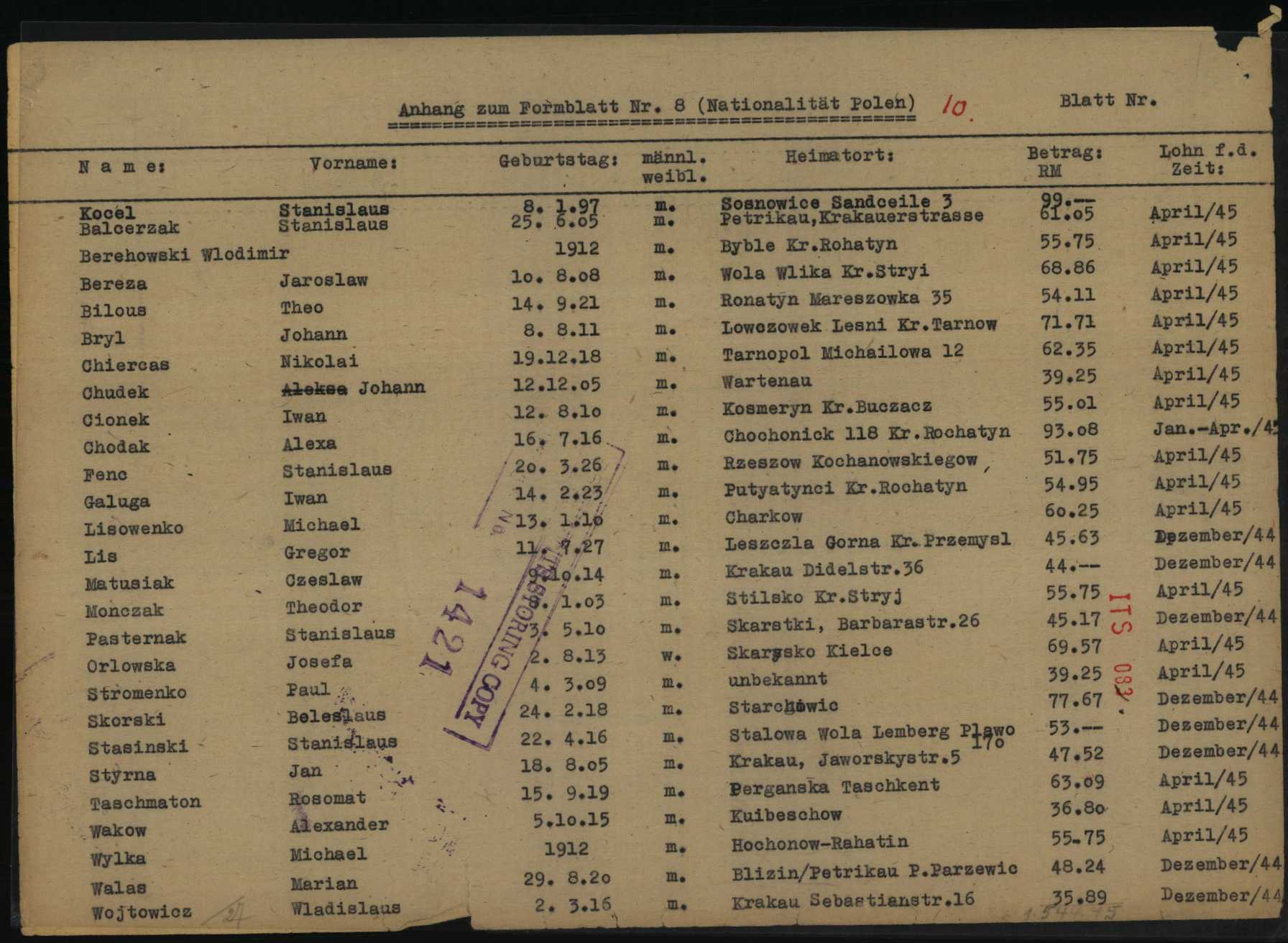
| Undated, probably 1947 | Wage list, appendix to Form 8 | 54.95 RM for April 1945 | 083 |
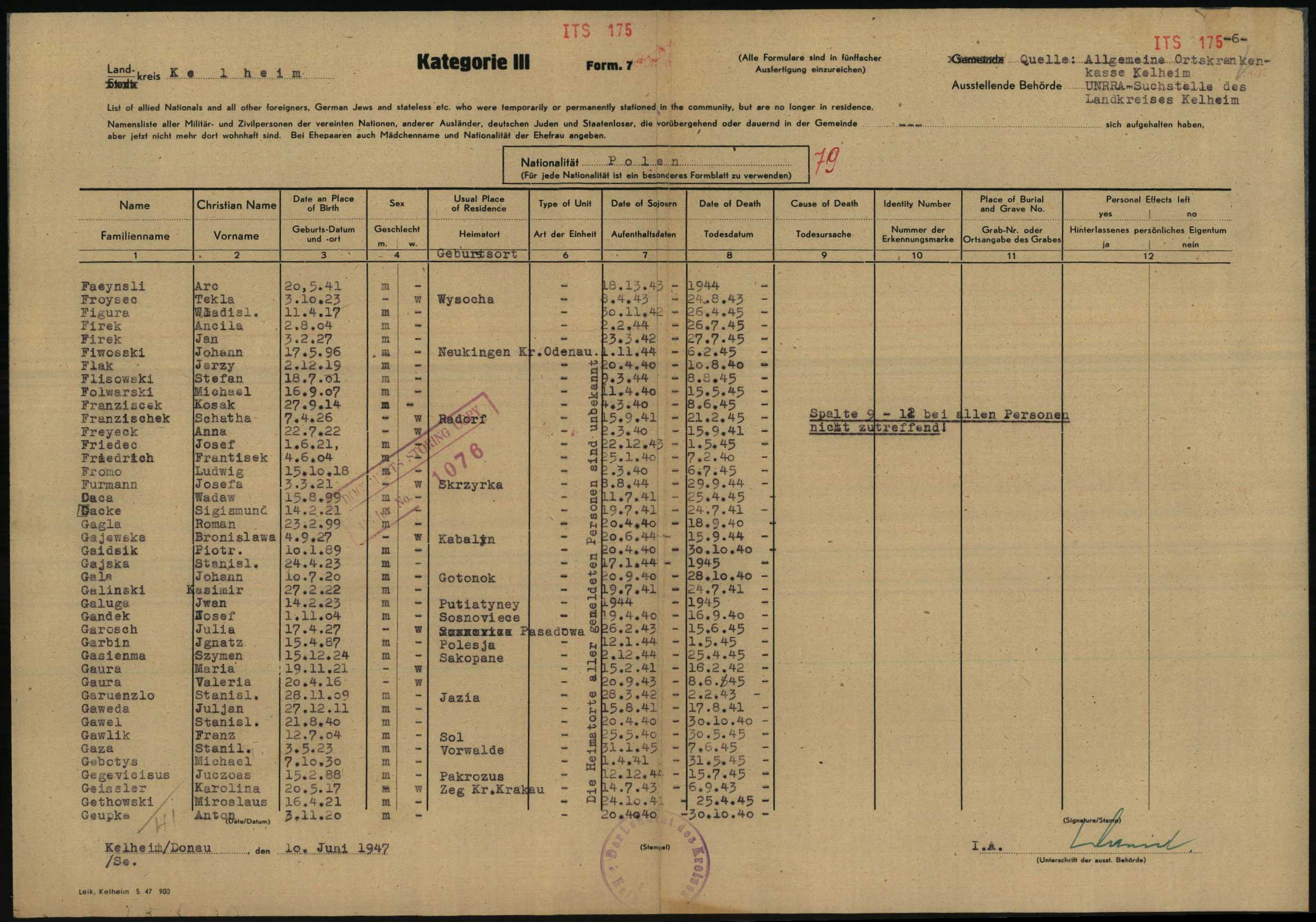
| 10 Jun 1947 | Kelheim, Form 7, Poles | Stay 1944, “1945” in the death column | 175 |
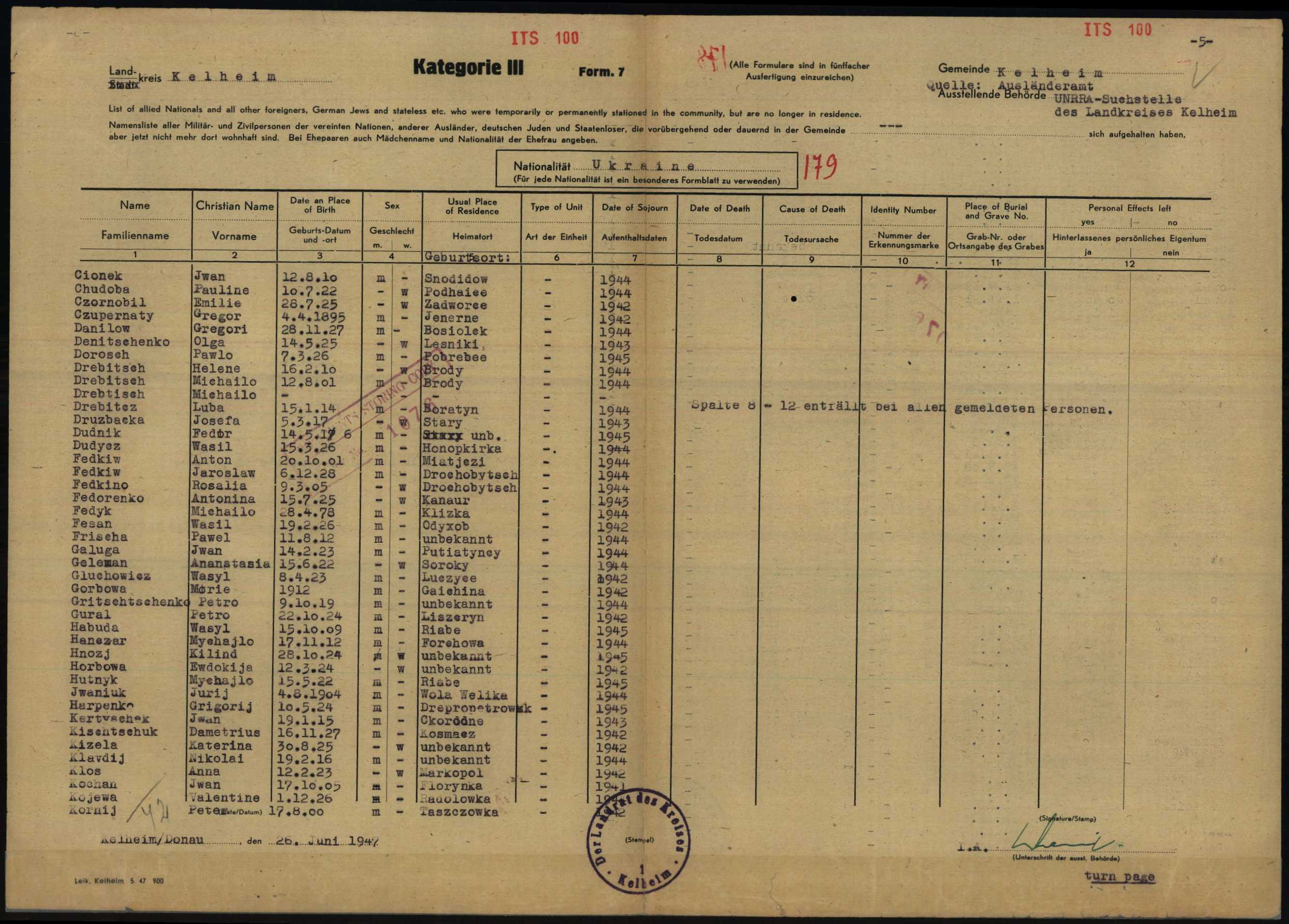
| 26 Jun 1947 | Kelheim, Form 7, Ukrainians | Stay 1944, no end date | 100 |
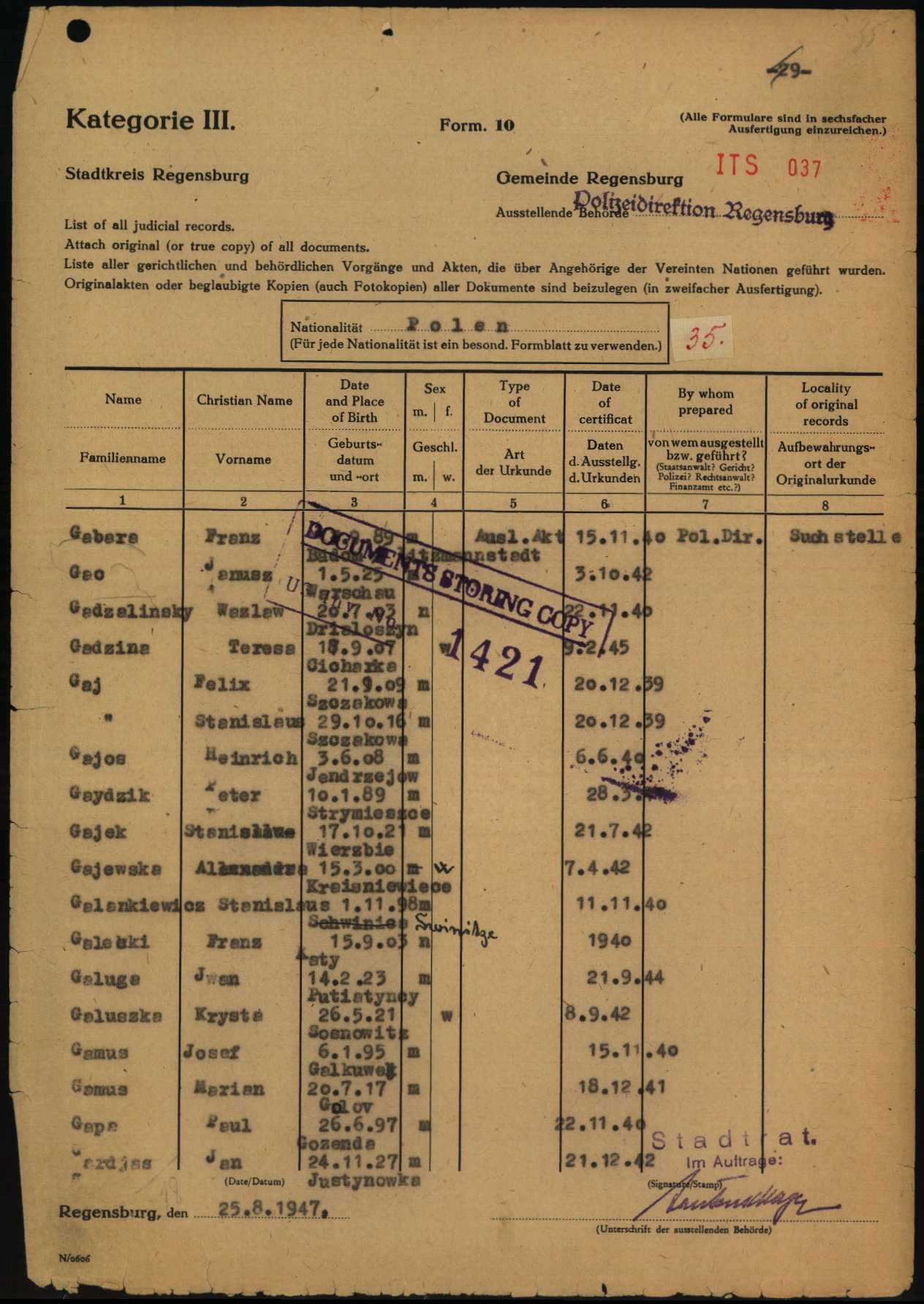
| 25 Aug 1947 | Police, Regensburg, Form 10 | Foreigner’s file dated 21.9.44 | 037 |
Where he worked: a Regensburg plant
The richest records come from his employer. On 28 May 1947 the Süddeutsche Holzverzuckerungswerke A.-G. filed a Form 7 listing its Polish workers. Iwan is listed as a helper from 10 July 1944 to 22 April 1945. One digit of the start year is smudged and can be misread as 1945, but he cannot have started after his recorded end date, and the police, insurance and wage records all point to July 1944.
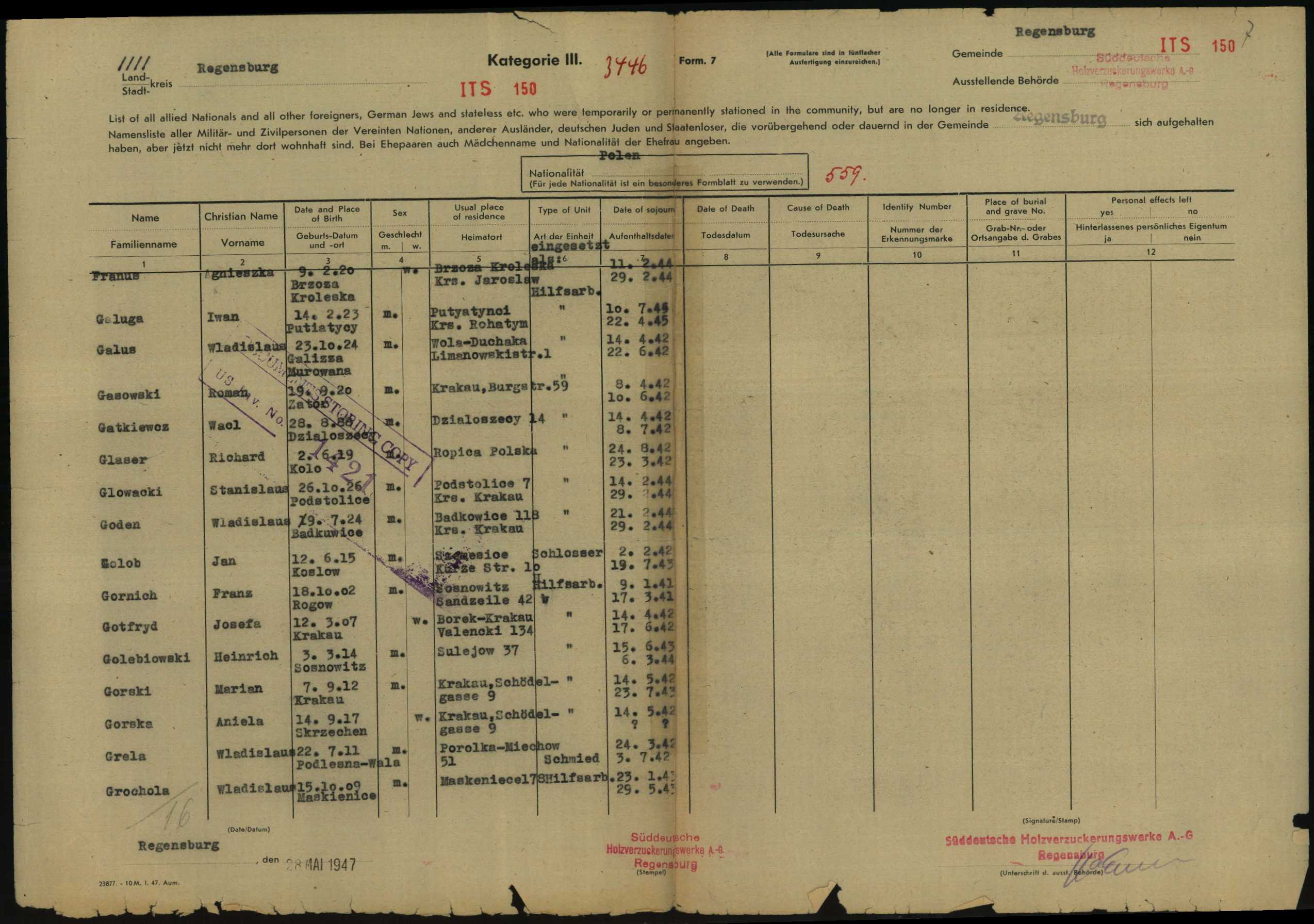
The same plant filed a Form 10 on the same day, listing the personnel files (Personalakt) it held on its Polish workers. Iwan has one.
A third sheet puts a number on his work. It is an appendix to a Form 8, a wage list of Polish workers, and shows 54.95 Reichsmark for April 1945. It does not name the employer, and it is undated. Names around Iwan’s also appear on the plant’s lists, so it probably comes from the plant’s payroll and was filed in 1947, but that is our inference, not something the sheet states.
The health-insurance lists
The Allgemeine Ortskrankenkasse (AOK), the local health-insurance fund, kept a card file on insured workers. Two Regensburg lists from August 1946 show Iwan’s card: one dates it 10 July 1944, the other gives only the year 1944. These lists carry a margin note that the fund did not know birthplaces, so Iwan matches here on name and birth date alone, not on Putyatyntsi.
On 30 April 1947 the AOK’s Kelheim branch office filed its own Form 11. Its certificate column gives a from–to range, and Iwan’s reads 1944–1945. Page 1 does not include him, but it is worth a look because it shows how the form works. One entry on it carries the note gestorben (died). Iwan’s row has no such note. A line at the foot of the page adds that the people listed are “simultaneously” recorded on Form 7, which explains something odd on the Kelheim Form 7 below.
The police lists
The Regensburg police (Polizeidirektion) filed two lists. The first, a Form 7 dated 29 August 1946, has Iwan in Regensburg from 9 July 1944, a day before his employer’s start date. The end date is a question mark. Since this form type lists foreigners who are no longer in residence, one might read it as saying he had left by August 1946. The question mark prevents that conclusion. See “What we don’t know” below.
The second, a Form 10 dated 25 August 1947, lists the foreigners’ files (Ausländerakte) the police held. Iwan’s file is dated 21 September 1944, about ten weeks after his arrival, which suggests it was opened when he was registered. The sheet itself only calls it the date of the certificate.
Kelheim: listed as a Pole and as a Ukrainian
Iwan also turns up in the neighboring district of Kelheim, on two different lists. Forms were made out separately for each nationality, and he is on both the Polish and the Ukrainian one. Before 1939, Putyatyntsi lay in Poland, so official papers often called its Ukrainian residents Polish. By 1947 some offices recorded them as Ukrainians. A search of the archive for only one nationality would have missed half of this.
On the 10 June 1947 Form 7 for Poles, compiled from AOK Kelheim records, Iwan has a stay in 1944 and “1945” in the column headed date of death. This is not a death record. It repeats the end date of his insurance card, because the Kelheim insurance office listed the same people on Form 7 at the same time (see the note on Form 11 above). A real death looks different, like the gestorben note on the insurance list.
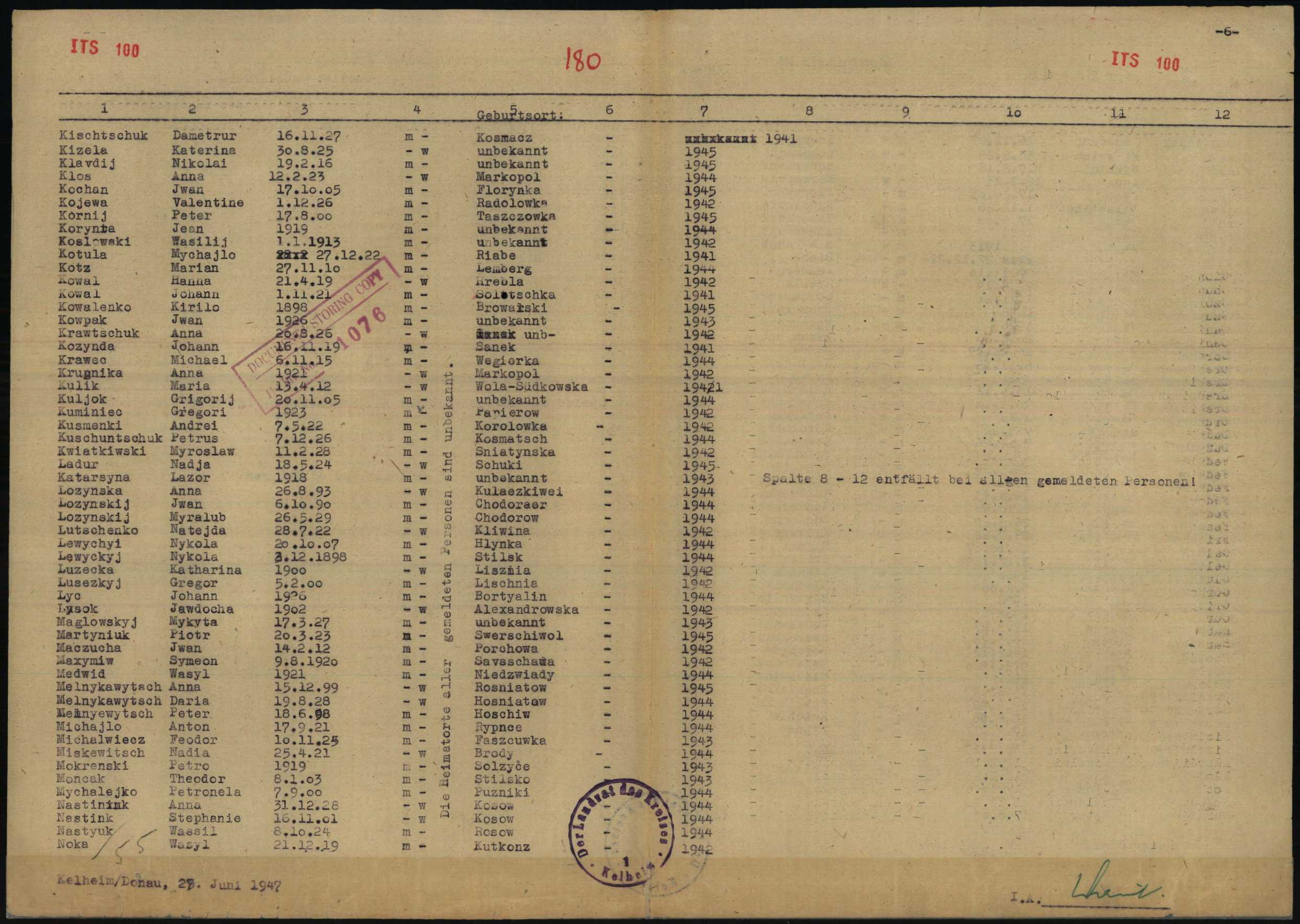
On the 26 June 1947 Form 7 for Ukrainians, from the Kelheim foreigners’ office, the same man appears with a stay in 1944 and no end date. The list runs onto a second page, which does not include him. We show it so the document is complete.
An undated address list
One page has no date, issuer or form number. It is a typed list of Poles in Regensburg with birth dates, birthplaces, occupations and street addresses, and it is the only record we have of where Iwan lived. He is entered as “Jwan” Galuga, born 14 February 1923 in “Pütietgncy”, a farm laborer (Landarb.), at Donaustauferstraße 378. The next entry, another Polish helper, gives the same address, so it may have been a shared residence.
We date this sheet to 1944 by inference. Other records place Iwan in Regensburg then, and his occupation listed here, farm laborer, certainly refers to what he did in Ukraine, prior to coming to Germany to work.
What we don’t know
- When, or whether, Iwan left Regensburg. The 29 August 1946 police list is a Form 7, which by its heading covers people who are “no longer in residence”. But his end date is blank, so the sheet does not tell us when or whether he had left Regensburg by the time it was issued. Nothing else we have settles it.
- Why Kelheim. Three Kelheim lists record him for 1944 and 1945, while the plant that employed him was in Regensburg. The Kelheim lists give no address, and we cannot say whether he lived or worked in that district or whether the insurance office’s Kelheim branch simply handled his card.
- How he came to Regensburg. None of these forms says how Iwan came.
- Two inferences. The wage list’s link to the plant, and the mid-1944 date of the address list, are deductions, not statements in the documents.
- Namesakes. A search for “Iwan Galuga” also returns a prisoner-of-war record dated 11 December 1941. It has no birth date or birthplace, so the name is its only link to our Iwan. The records above show a man who was alive and working in Germany long after that date, so we treat it as a different person.
How to search the Arolsen Archives for your own relatives
- Start at the Arolsen Archives online search with a surname, then try spelling variants. Iwan was typed “Iwan” and “Jwan”, and his village appears as Putiatyncy, Putiatycy, Putyatynci and Pütietgncy.
- Try every spelling of the village on our spelling variants page, and search surnames in German and Polish transliteration too. Our list of Putyatyntsi surnames can suggest variants.
- Search under both Polish and Ukrainian nationality. The same person can be filed under each.
- Use the birth date and birthplace to separate namesakes. A name-only match is a lead, not an identification.
- Read the whole page, not just your relative’s row. The heading, form number, issuing office, date, stamps and notes at the foot all change what an entry means.
- Write down the ITS number and form type for every scan. If a list mentions a file, such as a Personalakt or Ausländerakte, ask the archive whether it holds it.
Our Resource Library lists the Arolsen Archives alongside other sources for Putyatyntsi and Rochester genealogy.
Do you recognize Iwan Galuga, or a family member who was in Regensburg or Kelheim after the war? Please share what you know in the comments.
Source: Arolsen Archives, International Center on Nazi Persecution, documents ITS 011, 021, 037, 083, 100, 109, 125, 139, 150 and 175, as noted in each caption.


Leave a Reply